

Nearly every police agency in New Jersey now uses license plate readers, quietly logging millions of drivers’ movements for years at a time. Here’s how the network works.
WEBDESK – SAMAN NOOR – NJNEWSLINE
A Watchful Eye on Every Street Corner
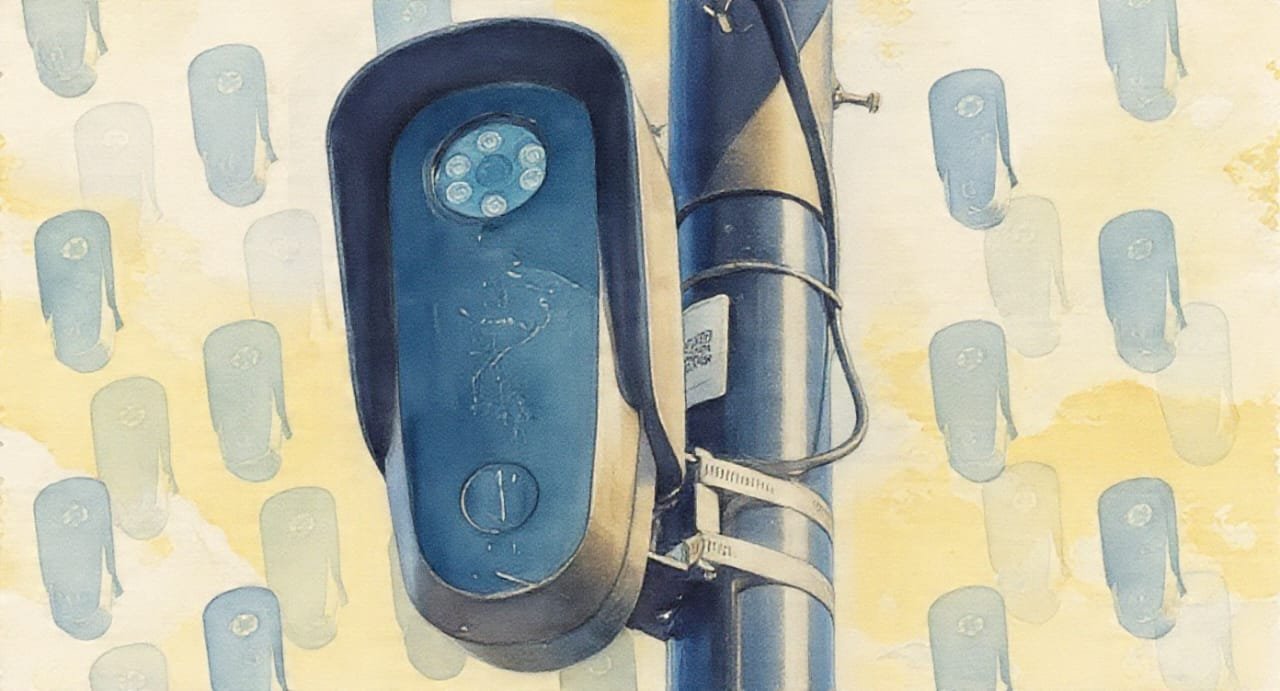
On Paul Robeson Boulevard in New Brunswick, a small camera mounted on a slim pole quietly tracks every car that passes. Two blocks away, another watches Remsen Avenue. A few blocks farther, a third keeps a steady eye on a quiet residential street across from a neighborhood bakery. These aren’t ordinary traffic cameras they’re automated license plate readers, devices that log the plate number, make, model and color of every vehicle that drives by. All three were made by the country’s fastest-growing manufacturer of the technology.
Keep driving and the cameras multiply, often blending into the background: CCTV bolted to utility poles, cameras dangling above intersections, plate readers tucked beside stoplights. Most people never notice them. But across New Jersey, law enforcement agencies have come to depend heavily on this technology to recover stolen vehicles and investigate violent crime, contracting with several major surveillance vendors to build out the system.
A Massive, Mostly Invisible Network
The numbers reveal just how far this surveillance has spread. The state’s most recent annual audit found that 523 law enforcement agencies out of roughly 530 statewide now use license plate readers. In other words, if you’ve driven virtually anywhere in New Jersey, there’s a strong chance your vehicle has already been captured on camera. The technology itself isn’t new, but it has grown dramatically more powerful and far more widespread, reaching into nearly every corner of the state.
Each scan doesn’t just capture a plate number it’s logged with the exact time and location, quietly building a detailed record of where people go. New Jersey holds onto that data for three years, far longer than most of the country, where retention periods typically range from 30 days down to as little as five minutes. In those shorter-retention states, the cameras function more like an alert system than an archive, checking each plate against databases of stolen cars, wanted vehicles and missing persons, then deleting the record if there’s no match. New Jersey takes a different approach and there’s no official public map showing residents where the cameras are located.
Who’s Watching, and Who They’re Sharing With?
Privacy advocates say most drivers have no idea how extensive this tracking really is. An attorney with a nonprofit group that monitors technology’s impact on civil liberties explained that this kind of data can be used to reconstruct someone’s daily movements where they work, where they live, even where they go to the doctor or worship.
Records obtained from individual police departments show just how far that data travels once it’s collected. The Burlington County Prosecutor’s Office shares its license plate data with 32 outside agencies. Franklin Township shares with 54. Edison shares with 88 including police departments as far away as New York, Texas and California, along with the U.S. Postal Inspection Service and several national intelligence-sharing centers. As the same privacy attorney put it, trusting this system means trusting that every single one of those agencies will handle the data responsibly and never misuse it a level of blind faith many drivers never agreed to.
The Companies Behind the Cameras and Their Silence
Despite building the infrastructure quietly reshaping daily life for millions of New Jersey drivers, most of the companies behind it declined to explain how it works. One major manufacturer canceled a scheduled interview and never responded to a detailed list of follow-up questions. Two other well-known vendors didn’t respond at all.
Two companies did respond, and both defended the technology, arguing that oversight responsibility falls on the government agencies that operate the cameras not the companies that build them. One vendor’s CEO confirmed that its cameras can identify vehicles by make, model and color, but insisted those capabilities exist to support legitimate law enforcement investigations, not to enable indiscriminate surveillance of ordinary people.
A System Built to Catch Few, Watching Everyone
That tension between targeted law enforcement tools and mass, ongoing surveillance sits at the heart of the debate. As one privacy advocate summed it up, the system is designed to catch a small number of wanted vehicles or missing persons, but in order to do that, it ends up recording everyone. With hundreds of agencies now plugged into a data-sharing web that stretches across state lines and into federal intelligence networks, New Jersey’s license plate readers have quietly become one of the most far-reaching surveillance systems most residents don’t know exists until they start looking for the cameras themselves.
