

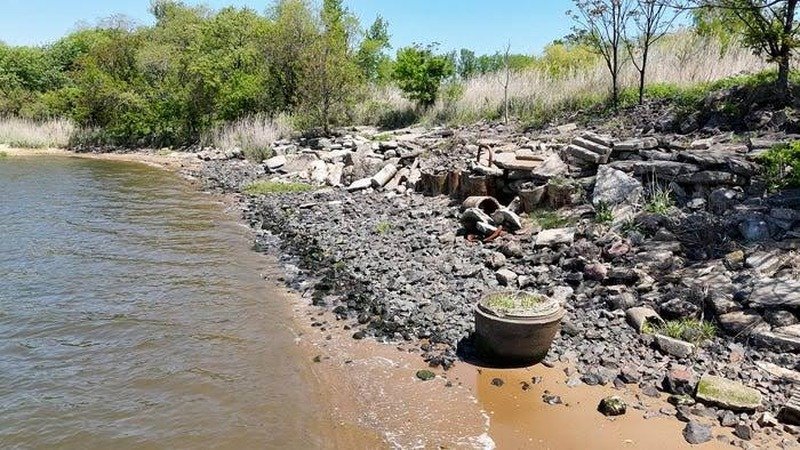
A new investigation near Keyport’s abandoned Aero marine landfill found elevated toxic metals in neighborhood soil, raising concerns among residents and prompting calls for broader environmental testing.
WEBDESK – HAJIRA IRFAN – NJNEWSLINE
A Neighborhood’s Growing Fear Over What Lies Beneath
For years, families in a quiet New Jersey neighborhood have lived with an unsettling question: could something hidden beneath the ground be affecting their health?
Now, a new environmental study has intensified those concerns after researchers found elevated levels of toxic metals in soil near the abandoned Aero marine landfill in Keyport.
The study, commissioned by NJ.com and conducted by researchers from New York University, identified a potential “hot spot” of heavy metal contamination in areas surrounding the former landfill.
While the findings do not prove that the contamination caused cancer cases reported by residents, experts say they highlight the urgent need for more testing.
Testing Reveals Elevated Levels of Multiple Metals
Researchers analyzed soil samples from 43 locations throughout Keyport using an X-ray fluorescence (XRF) device, a technology that detects and measures metal concentrations.
The study detected 29 metals, including arsenic, lead, cobalt, antimony, nickel and vanadium.
Several samples showed levels above New Jersey’s environmental standards, with some areas reaching concentrations high enough to trigger cleanup concerns under state guidelines.
Researchers identified a potential contamination zone around First Street, Cedar Street, Pine Street and Walnut Street, an area that overlaps with locations where residents have reported a significant number of cancer cases.
Experts Warn That More Answers Are Needed
Environmental scientists stressed that the findings should not be interpreted as proof that the landfill contamination is responsible for illnesses in the community.
However, they said the results raise important questions about whether residents could be exposed to harmful substances through soil contact, dust, outdoor activities or contaminated material being carried into homes.
Judith Zelikoff, a professor of toxicology and environmental health, said the findings provide enough warning signs to justify expanded testing in residential neighborhoods, parks and other public spaces.
Researchers also clarified that the study focused only on metals and did not examine other pollutants, including volatile organic compounds such as benzene and vinyl chloride, which have previously been detected at the landfill site.
State Officials Say No Direct Link Has Been Confirmed
The New Jersey Department of Environmental Protection has previously said that testing at the Aero marine property has not identified a confirmed pathway showing how contaminants could reach nearby residents.
However, researchers involved in the study questioned whether that conclusion can be made without examining areas outside the landfill, including homes, playgrounds and community spaces.
Experts said additional testing, including deeper soil analysis and broader environmental sampling, will be necessary to better understand the situation.
Residents Continue to Demand Action
For people living near the former landfill, the issue is not just about soil samples and scientific reports, it is about protecting their families and understanding what risks may exist around them.
Residents have repeatedly called for testing in their neighborhoods, raising concerns about possible contamination spreading through soil, flooding and nearby waterways.
Scientists said exposure risks depend on several factors, including how much contact people have with contaminated areas and how long that exposure continues.
They also emphasized that the current findings do not mean residents need to leave their homes, but they do show why further investigation is important.
The Search for Answers Continues
The new study has added another layer of concern to Keyport’s long-running environmental debate.
Although researchers have not confirmed that toxic metals are responsible for the community’s reported cancer cases, they say the findings cannot be ignored.
For residents living near the Aero marine landfill, the hope is simple: more testing, clearer answers and reassurance that the place they call home is safe. Until those answers come, a quiet neighborhood in New Jersey remains caught between fear and the search for the truth.
