

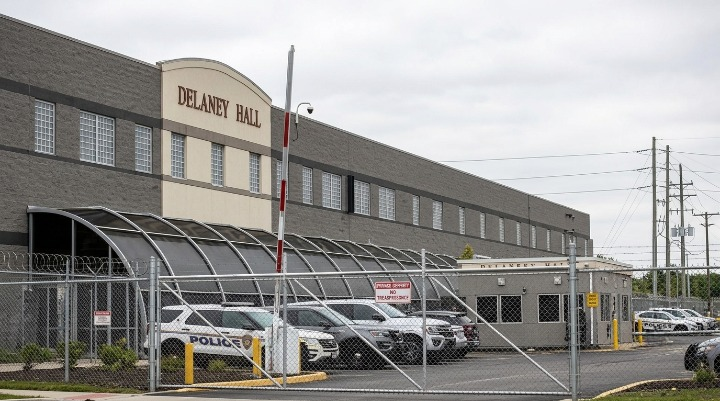
A 41-year-old Salvadoran man has died after a medical emergency while detained at Newark’s Delaney Hall, renewing scrutiny over conditions, healthcare, and oversight.
WEBDESK – NJNEWSLINE
Detainee Dies After Medical Emergency at Delaney Hall
A 41-year-old Salvadoran man, Edwin Lopez-Cornejo, died while in U.S. Immigration and Customs Enforcement custody at the Delaney Hall Detention Facility in Newark, New Jersey. His death has renewed scrutiny of the facility, which has faced months of protests and criticism over detainee treatment, healthcare and government oversight.
Lopez-Cornejo was detained after being arrested by immigration authorities on June 18, 2026. According to ICE, he experienced a medical emergency while being held at Delaney Hall and was taken to University Hospital in Newark, where he died on August 1.
The official cause of death has not been released. Authorities say additional medical examination is required before the circumstances surrounding his death can be formally established.
The case is drawing particular attention because Delaney Hall has already become the center of a wider debate over immigration detention and the conditions faced by people held inside the Newark facility.
Officials Face Renewed Questions Over Facility Conditions
Delaney Hall, a privately operated immigration detention center, has faced growing scrutiny throughout 2026. The facility is operated by GEO Group and has become a focal point for protesters, lawmakers and community organizations concerned about conditions and detainee welfare.
Lopez-Cornejo’s death has intensified those concerns, particularly because another detainee died at the facility in December 2025. Jean Wilson Brutus, a 41-year-old Haitian national, experienced a medical emergency shortly after entering ICE custody and later died at University Hospital.
The two deaths have prompted renewed questions about the medical services available to detainees and whether outside authorities have enough access to independently examine conditions inside the facility.
New Jersey officials have previously raised concerns about inspection access. State health officials have faced restrictions when attempting to inspect parts of Delaney Hall, adding another dimension to the ongoing debate over transparency and accountability.
ICE Says Medical Care Was Provided
Federal authorities have defended the medical care available at Delaney Hall.
In response to questions surrounding Lopez-Cornejo’s death, ICE said he received medical attention while in custody. The agency has also indicated that the final cause of death will depend on further medical examination.
According to reports, facility personnel and medical staff responded after Lopez-Cornejo suffered the emergency. Emergency services were contacted, and he was transported to University Hospital, where he later died.
ICE has previously maintained that detainees have access to comprehensive medical services. However, critics continue to question whether those services are sufficient and whether independent officials are given enough access to verify conditions.
That disagreement is likely to remain central as authorities investigate the latest death.
Newark Leaders Push for Greater Oversight
Delaney Hall has faced criticism from Newark officials and New Jersey leaders for months.
Newark Mayor Ras Baraka has previously called for greater oversight and an independent examination of conditions at the facility. Local officials have also raised concerns about access for agencies responsible for health, fire safety and code enforcement.
Officials argue that limited access can make it difficult for local authorities to independently assess whether the facility is meeting appropriate safety and health standards.
The controversy has also involved New Jersey’s state government. Gov. Mikie Sherrill has called for greater access for state health officials and raised concerns about conditions inside the detention center.
Sherrill previously toured the facility but said her visit was restricted and that she was unable to speak directly with detainees. Federal authorities defended the restrictions, creating further disagreement over how much independent oversight should be permitted.
Previous Death Added to Growing Scrutiny
Lopez-Cornejo’s death is not the first fatality associated with Delaney Hall.
In December 2025, Jean Wilson Brutus died after experiencing a medical emergency while in ICE custody. He was taken to University Hospital in Newark, where he was pronounced dead.
Authorities at the time indicated that natural causes were suspected. However, Brutus’ death still generated calls for greater scrutiny of medical procedures at the facility.
His relatives later sought legal assistance to examine the circumstances surrounding his death. Attorneys representing the family raised questions about his health before detention and called for further examination of what happened while he was in custody.
The latest case has therefore added to an already sensitive discussion.
For critics, the deaths raise concerns about how quickly medical emergencies are recognized and treated. Federal authorities, however, have emphasized that the circumstances of each case must be determined through appropriate medical and official reviews.
Protests Have Kept Delaney Hall in the Spotlight
Delaney Hall has also been the site of sustained demonstrations during 2026.
Protests have included concerns about alleged living conditions, food, healthcare and immigration proceedings. Some demonstrations eventually resulted in confrontations between protesters and law enforcement outside the facility.
Newark authorities at one point imposed a nightly curfew around Delaney Hall following clashes involving protesters and police. Officials said some demonstrators crossed barriers and threw objects, while activists continued to raise concerns about detainee treatment.
The protests have helped turn Delaney Hall into one of the most visible locations in New Jersey’s broader debate over immigration enforcement and detention.
Lopez-Cornejo’s death is expected to bring renewed attention to those demonstrations and the concerns that have surrounded the facility.
Healthcare Remains a Major Concern
Medical care has remained one of the most frequently raised issues surrounding Delaney Hall.
New Jersey officials, congressional representatives and civil rights organizations have called for greater transparency regarding healthcare services and detainee conditions.
A congressional inspection earlier this year also raised concerns about areas including medical treatment, sanitation and language access inside the facility.
Civil rights groups have separately made allegations about inadequate treatment and poor conditions. Those claims remain disputed and should not be treated as established facts unless supported by independent investigations or official findings.
The latest death could increase pressure on federal authorities to provide more information about the medical emergency, the response from facility staff and the circumstances leading to Lopez-Cornejo’s hospitalization.
Cause of Death Remains Unknown
The precise cause of Lopez-Cornejo’s death remains undetermined.
ICE has indicated that further medical examination is required before an official cause can be established. Until those findings are released, it is not possible to determine whether his death was linked to an existing medical condition, an acute medical event or another factor.
Authorities have also notified relevant oversight bodies and the Salvadoran consulate, according to reports.
The investigation is expected to receive considerable attention because of Delaney Hall’s existing history of controversy and the earlier death of Brutus.
The findings could help clarify what happened before Lopez-Cornejo was taken to University Hospital and whether any additional questions regarding his medical care need to be addressed.
Delaney Hall Remains at the Center of Immigration Debate
The controversy surrounding Delaney Hall extends beyond the latest death.
Supporters of immigration enforcement argue that federal authorities need secure facilities for people involved in immigration proceedings. Critics, meanwhile, say detention centers must maintain strong standards for healthcare, safety, sanitation and humane treatment.
Those competing positions have placed federal agencies, state and local officials, protesters, advocacy groups and the facility’s private operator on opposing sides of a highly sensitive political debate.
The latest death has brought those disagreements back into focus while questions about immigration detention continue to dominate political discussion across New Jersey and the United States.
The investigation into Lopez-Cornejo’s death will likely determine the next stage of the debate surrounding Delaney Hall.
Authorities are expected to examine his medical history, the circumstances of the emergency, the response provided by facility personnel and the treatment he received after being transported to University Hospital.
For Newark and New Jersey officials, the case could strengthen calls for independent inspections and greater access to the facility.
For federal authorities, the immediate priority will be establishing the official cause of death and providing information about the medical care Lopez-Cornejo received while in custody.
For now, the confirmed information remains limited: Lopez-Cornejo died after experiencing a medical emergency while in ICE custody, and the official cause of death remains pending.
His death nevertheless represents another serious development for Delaney Hall, a facility already facing months of protests, political disputes and questions over detainee healthcare and oversight.
