
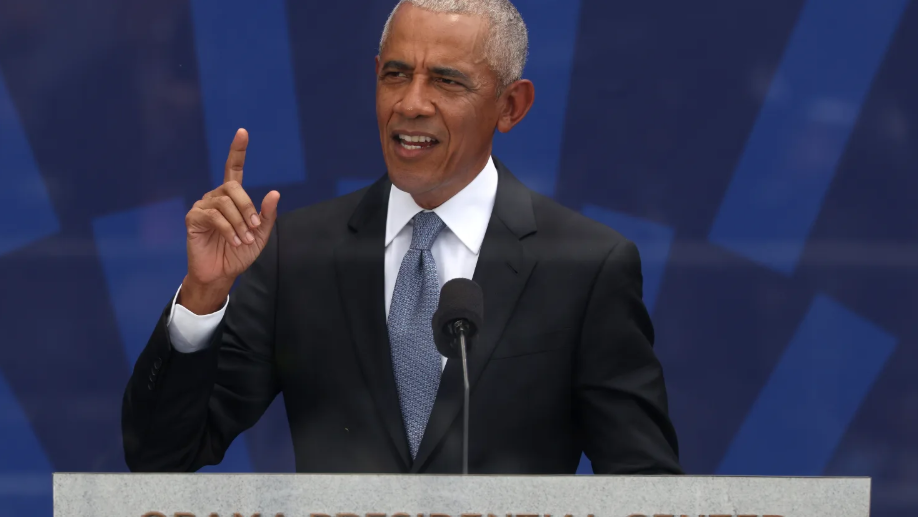
Former President Barack Obama is urging Democrats, including 2028 presidential candidates and congressional leaders, to more aggressively focus on a comprehensive AI agenda, warning that the technology is at an inflection point.
“This is something that is moving very fast in private hands, and if we don’t get on top of it, I think can be dangerous,” Obama said at a private fundraiser Thursday. “If we do get on top of it, I do think it’s beneficial.”
Speaking alongside House Minority Leader Hakeem Jeffries at the New York Historical Society in Manhattan, Obama said he is neither a “doomer” nor an “accelerationist.” His remarks come amid growing concern over the rapid development of AI and calls from some technology leaders for governments to slow its progress.
Obama said AI development would be “one of my central agendas” if he were running for president, challenging Democrats to make the technology a major part of their policy platform.
“I would have a very clear plan,” Obama said, outlining priorities that would include AI safety, protecting children, managing job displacement and strengthening the social safety net.
Obama Calls for a Clear AI Plan
Among his biggest concerns is the potential economic impact of AI.
Obama said policymakers need to understand where job displacement will occur, how workers will be affected and whether limits should be placed on the amount of displacement.
He also warned that a major increase in the number of people unable to find full time work could put significant pressure on the country’s social safety net.
Obama called on Congress to “put together a framework for a very public conversation” around the biggest questions surrounding AI.
A Major Shift for Obama and Democrats
Obama’s remarks represent a broader shift for both himself and the Democratic Party.
During his presidency, Obama was widely viewed as tech friendly and closely connected to Silicon Valley. His administration also became known for embracing emerging technology.
However, the Obama era was also marked by criticism over Washington’s failure to confront the growing concentration of power within the technology industry, including the 2013 decision by the Federal Trade Commission not to file an antitrust lawsuit against Google.
Now, Obama is urging Democrats to take a much more active role in determining how AI develops.
Potential 2028 Candidates Join the Debate
At least two potential 2028 Democratic presidential candidates have already addressed the need for greater controls on AI.
Former Transportation Secretary Pete Buttigieg said Democrats need to address the technology “head on.”
“There needs to be safeguards. There need to be rules. There need to be limits. There needs to be a kill switch on rogue AI,” Buttigieg said.
Pennsylvania Gov. Josh Shapiro, who has shifted from actively courting AI investment to raising concerns about data center development, also called for the federal government to take stronger action.
Shapiro said it was “long past time” for Washington to take AI seriously and establish guardrails both in the United States and internationally.
Democrats Remain Divided Over AI
Calls for guardrails remain more moderate than proposals from the progressive wing of the Democratic Party.
Sen. Bernie Sanders and Rep. Greg Casar have proposed pausing the development of advanced AI models and permanently banning “artificial superintelligence.”
Obama’s remarks also highlight what some Democrats see as a leadership vacuum within the party following its difficult 2024 election losses.
Obama acknowledged that Democrats need to give voters a reason to believe in the “democratic project” and an economy that provides opportunity for everyone.
Trump Takes a Different Approach
President Donald Trump, meanwhile, has dismissed concerns about AI posing an existential threat.
Trump has said his main concern is ensuring the United States beats China in the race to dominate AI.
Obama compared AI with other potentially dangerous technologies, including nuclear power, but noted that AI does not face the same physical limitations and may increasingly operate outside direct government control.
Congress Faces Pressure to Act
Lawmakers in both the House and Senate have introduced legislation aimed at slowing AI development and establishing safety requirements, but major proposals have so far struggled to advance.
One Senate proposal led by Sen. Amy Klobuchar and Senate Majority Leader John Thune faces uncertainty over disagreements about how technology companies should be held legally responsible for harm caused by their AI systems.
Another major debate involves whether federal AI legislation should prevent individual states from creating their own AI laws.
House Speaker Mike Johnson said Sunday that he supports discussions with technology leaders about AI safety, but argued that developers, rather than Congress, should remain primarily responsible for ensuring their products are safe.
As lawmakers campaign ahead of the midterm elections, AI is increasingly becoming a political issue, with voters raising concerns about data centers, jobs, education and the broader impact of AI systems.
For Democrats, Obama’s message is increasingly clear: AI can no longer be treated as a side issue. It needs to become a central part of the party’s political and economic agenda.
