

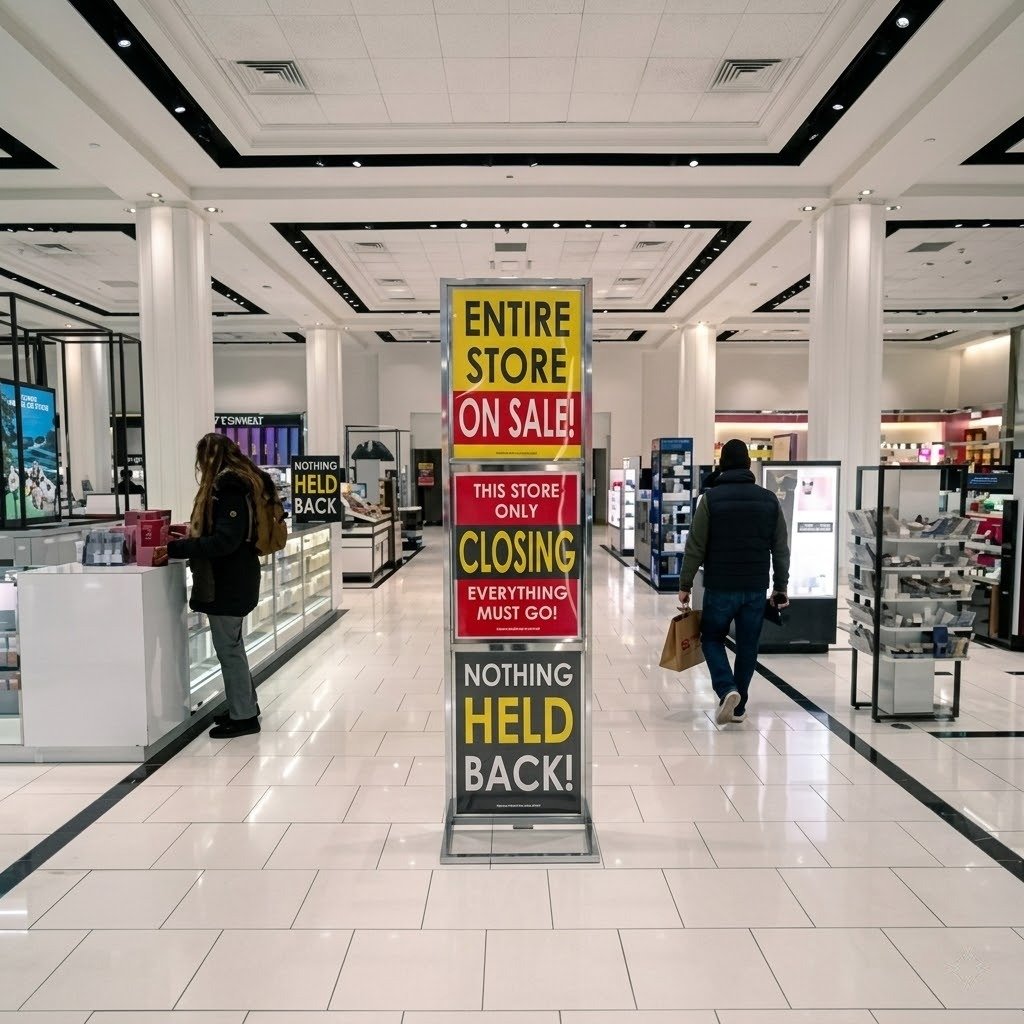
Store and bank closures are rising across New Jersey as big chains scale back physical locations. Digital banking and online shopping are reshaping the retail economy rapidly.
WEBDESK – NJNEWSLINE
A growing wave of store and bank closures is sweeping across New Jersey as major retail chains and financial institutions scale back their physical presence. The trend has raised concerns among communities, employees, and local business owners who are witnessing significant changes in the retail landscape.
Industry observers say the closures reflect broader economic shifts, including increased digital banking, online shopping growth, and rising operational costs for physical outlets.
The situation is reshaping how consumers interact with banks and retail stores, with many services now moving online or to smaller branch formats.
Rising Trend of Retail and Bank Shutdowns
Across New Jersey, multiple retail outlets and bank branches have recently shut down or announced plans to close in the near future. These decisions are often linked to cost-cutting strategies by large corporations.
Big chains are reassessing their physical footprint, focusing more on digital platforms and fewer but more efficient locations. This shift is part of a long-term transformation in how businesses operate in the modern economy.
For many local communities, however, these closures mean reduced access to in-person services and longer travel distances for banking and shopping needs.
Impact on Jobs and Local Communities
The closure of stores and banks has a direct impact on employment, particularly for retail workers, cashiers, and branch staff. Many employees face uncertainty as companies restructure operations.
Local economies also feel the effect when major outlets shut down, as surrounding businesses often rely on foot traffic generated by these locations.
Community leaders have expressed concern that repeated closures could weaken neighborhood commercial activity and reduce economic stability in some areas.
Shift Toward Digital Banking and Online Shopping
One of the main reasons behind these closures is the rapid shift toward digital services. More customers are now using mobile banking apps and online shopping platforms instead of visiting physical locations.
Banks are investing heavily in digital infrastructure, allowing customers to perform transactions without visiting branches. Similarly, retailers are expanding e-commerce operations to meet changing consumer preferences.
Experts believe this transformation is permanent and will continue to reshape both the banking and retail sectors in the coming years.
Corporate Strategy and Cost Reduction
Large companies are under increasing pressure to reduce costs and improve efficiency. Maintaining physical stores and bank branches has become expensive due to rent, staffing, and maintenance costs.
As a result, many organizations are closing underperforming locations and focusing on high-traffic or profitable areas.
This strategy allows businesses to remain competitive while adapting to rapidly changing consumer behavior.
Community Concerns and Economic Adjustment
Residents in affected areas have expressed concern over reduced access to essential services. For elderly individuals and those without digital access, physical bank branches remain important.
Similarly, small communities that lose major retail stores may experience reduced convenience and economic slowdown.
Local governments are now exploring ways to support affected communities and attract new businesses to vacant commercial spaces.
Pakistan Angle: Retail Transformation and Digital Banking Growth
A similar trend is also emerging in Pakistan, where digital banking and e-commerce platforms are gradually changing consumer habits. Mobile banking services and online marketplaces are becoming more popular in urban areas.
However, physical retail stores and bank branches still play a crucial role, especially in smaller cities and rural regions where digital access is limited.
Experts suggest that Pakistan can learn from global retail shifts by improving digital infrastructure while ensuring financial inclusion for all population groups.
The comparison highlights how both developed and developing economies are navigating the balance between physical services and digital transformation.
Future Outlook for Retail and Banking
Industry analysts predict that closures will continue as companies adapt to long-term digital trends. However, physical locations are not expected to disappear entirely.
Instead, businesses are likely to adopt hybrid models that combine digital services with fewer, more efficient physical branches.
As New Jersey continues to experience these changes, communities will need to adjust to a new retail and banking environment shaped by technology and evolving consumer expectations.
